2 3/4 INCH POTS $18
FOUR INCH POTS $29
SIX INCH POTS $45
ONE GALLON SIZE $60
| Articles | Home Page | Images | Order Form | Plant Catalog |
Cotoneaster (Benishitan) Deciduous and semi-evergreen shrubs with white or pink flowers with reddish berries. Some forms are variegated. Easy to grow plants for the landscape, rock garden, or bonsai. Cotoneaster continues to be one of the most popular plants for bonsai, especially for beginners since it may be styled and potted at a very young age and the flowers and fruit on these young plants can be quite striking. We grow many different varieties almost all of which are low growing and have good bonsai and rock garden potential.
For more information see the article Cotoneaster for Bonsai.
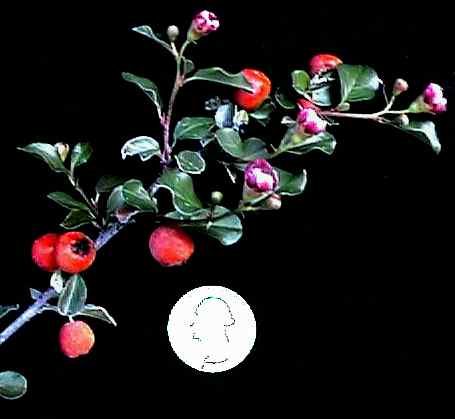
| 3190 Cotoneaster congestus
'Likiang' S\M\-30ø\Ls\RG\B Evergreen shrub, slow
growing to 3 feet with pink flowers and small bright red fruits.
Small almost round dark green leaves with lighter underside. Rock
hugging arched branch habit makes it especially fine for bonsai. 2 3/4 INCH POTS $18 FOUR INCH POTS $29 SIX INCH POTS $45 ONE GALLON SIZE $60 |
|
| 3200 Cotoneaster dammeri 'Emerald
Spray' S\PS\M\-40ø\Ls\RG\B Mounding shrub 2 feet x 6
feet with rounded shiny dark green leaves. White flowers followed
by very large red berries. Makes striking larger mame or shohin
sized bonsai. The four inch pots size are exceptional plants, over
six years old, pruned many times into nice upright moving shapes.
Each one is unique. 2 34 INCH POTS $18 FOUR INCH POTS $29 SIX INCH POTS $45 |
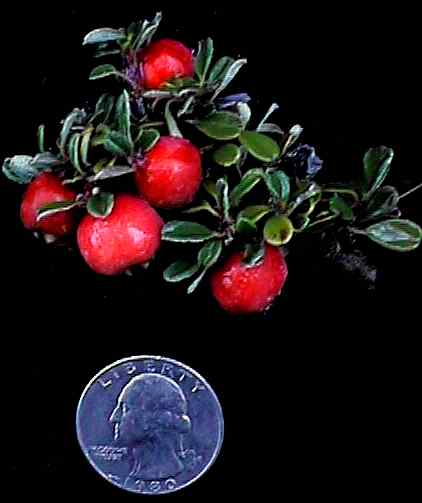 |
3230 Cotoneaster dammeri 'Streib's Findling'
S\M\-30ø\RG\Ls\B Slow growing evergreen mounding shrub to about 1 foot x 3
feet . Grows by short arching branches making it particularly useful for
bonsai. Dark green leaves almost round and red berries. One of the best
for small weeping bonsai!
2 3/4 INCH POTS $18
FOUR INCH POTS $29
ONE GALLON SIZE $60
Crataegus (Hawthorn) S\D\-40ø\Ls\B Deciduous trees with either white or pink flowers and small red apple-like fruits. Plants sucker and water sprout profusely. This can be controlled somewhat in landscape plants by limiting water and fertilizer and pruning only when necessary. Bonsai plants should have suckers removed as they appear. Leaves reduce nicely in bonsai plants. Seedling grown plants avoid nasty grafts for bonsai use but can take as long as 20 years to flower. Cutting grown plants are from mature wood, are capable of flowering immediately, and also avoid the graft problem. We are one of the very few nurseries in the world growing hawthorn from cuttings.
Specimen bonsai from cutting grown hawthorn are spectacular. The oak lobed leaves are very attractive and reduce nicely. A fine degree of ramification is possible once the roots are constrained in a bonsai pot. Older, well trained plants will be literally covered with flowers in the spring and loaded with ideal sized bright red fruit in the fall. The mature bark is scaly and in perfect proportion. Good branching is the most difficult aspect to achieve. New branches tend to shoot straight up, so young branches must be wired into position quickly. Once the branch framework is established, ramification is easily achieved through pinching the new growth.
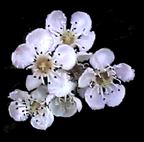
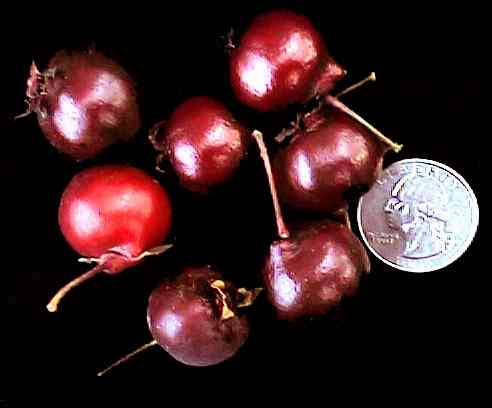
| 3250 Crataegus cuneata (Oriental
hawthorn) Deciduous tree or large shrub. The stems are thin and it
is not inclined to form large trunks, so shohin is probably the
best size for bonsai. The 3 inch leaves are fan shaped and have a
nice yellow fall color, single white flowers. The real attraction
is the giant 1inch red fruit that it sets, the biggest fruit of
any Hawthorn that I have seen. This large fruit and twiggy growth
make this plant especially interesting for bonsai. Our plants are
cutting grown and ready to flower. Leaf reduction and ramification
are good for this species, but getting trunk caliper is most
difficult. Unless you have decades to wait, better plan on using
them for shohin and smaller bonsai. These can be quite spectacular
with just one or a few of the large red fruit in the autumn. An
interesting project would be to graft scions of C. cuneata
to form the branches on C. laevigata, or other Crataegus, which form a nice
trunk. Cutting grown plants are very difficult to propagate, and
are almost impossible to find. Available Again in 2027? |
  |
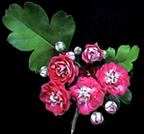
| 3270 Crataegus x media 'Paul's Scarlet' (English
hawthorn 'Paul's Scarlet') Same as above except flowers are
clusters of PINK double blooms. Despite its name, this is a pink
hawthorn, not red. One of the most popular hawthorns. Cutting
grown plants of this variety and above have good potential for
bonsai since ugly graft unions (and flower delay in seedlings) can
be avoided. The prolific flowers and fruit of this cultivar make
it a spectacular flowering bonsai subject.
Our two to four year old cutting grown plants in 2 3/4 inch
pots are quite vigorous and will be about ten to twelve inches
tall, mostly unbranched with caliper of about 3/16 inch or less.
Four inch size plants are at least five years old and have been
grown out and pruned down to about 12 inches with some
branching. Trunk caliper of about 5/16 inch or greater. One
gallon size plants are at least five years old, have trunk
caliper greater than 1/2 inch, and have been pruned down to
about 12 inches and are well branched.
|
  |
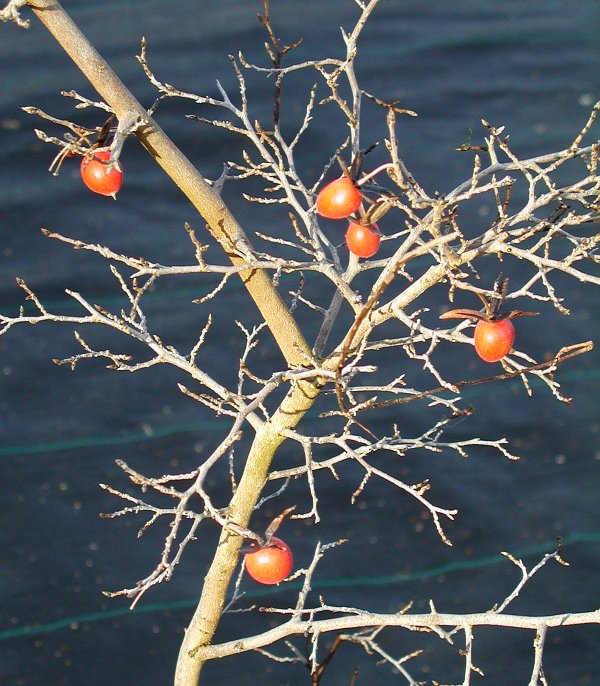
| 3580 Diospyros rhombifolia
(Princess Persimmon) Small leaved persimmons very popular for bonsai
because of their dwarf habit, small flowers and small round orange
fruit. Fruits are usually one to two inches. Leaves are one to two
inches long and dark green. Leaf stems, wood, and roots are black.
Very difficult to obtain in the US. D. rhombifolia is
polygamodioecious (whew!), that is, they are essentially dioecious
(male and female plants), but there are a few complete flowers on
some plants. For bonsai purposes, you should consider them to be
male and female. Only females will fruit and the presence of a male
plant will probably be necessary for pollination. At this time, we
can only offer unsexed seedlings, which will probably flower in
about five to seven years. Later, we hope to be able to sell cutting
grown plants of know sexual origin, or possibly some cultivars.
Probably hardy to zone 5. Unsexed seedlings Available Again 2027 |
 |
Fagus (Beech) I will never forget the beeches of my childhood on the east coast. Enormous steel-gray smooth trunks almost fairy-like. Beech, European and Japanese, are very popular for bonsai, both as group plantings and individual specimen upright trees. We are very fortunate to be able to offer Japanese Beech a very rare tree in this country and extremely difficult to obtain.
All species of beech share the common trait of being quite different in leaf and bud from most other deciduous trees. Mature plants generally set one set of leaves per season. The leaf buds are thick and fleshy and not very numerous. This requires a different strategy for bonsai growing. In general, they should not be trunk chopped like other deciduous trees, but rather grown out using sacrifice branches to obtain caliper. It is difficult to get good taper to the apex and maintain the fine ramification that is necessary. A good apex requires planning ahead, selecting a small upright branch in a good location, and cutting back to this point.
Pruning scars are also a problem. The species tends to develop a thick callus which will create an unsightly bulge. This is especially difficult in the top of the tree when selecting the apex. I have found that wrapping the cut area tightly with grafting tape will help minimize the bulge, but you should still try to have the scars placed to the back of the tree.
Beech will back bud, but with difficulty. Plants that are to be cut back should be young and vigorously growing. Try not to remove all of the preformed buds or you may lose the tree. Buds tend to form at branch collars, so overly thick branches can be removed and new, thinner ones started in the same location if you leave a small stub. This method can also be used to grow new branches where older branches have all their foliage at the tips. Beech are generally not defoliated, although it is possible to do it every few years for show purposes.
| Fagus sylvatica (European Beech) S\PS\M\-40ø\Ls\B Deciduous trees to 90 feet. Beautiful smooth gray bark even into great age and thick glossy green, copper, or purple leaves. Some varieties weep. Needs protection from afternoon sun in hottest driest areas and salt free water. Salts stunt the tree and turn leaves brown at the edge. For bonsai this can be overcome somewhat by acidifying the water and soil. Rusty fall color, leaves tend to stay on the tree most of the winter. A classic bonsai tree. | 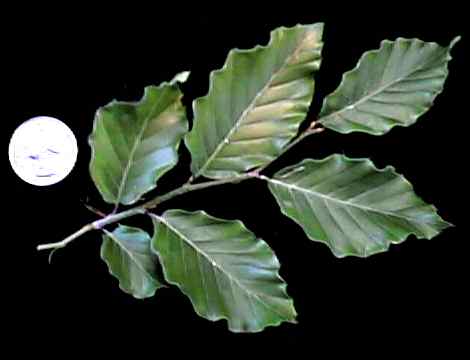 |
4050 Fagus sylvatica Seedling trees of the
species for landscape or bonsai use. For bonsai may be used as specimen or
group planting. Our 2 3/4 inch pot size are relatively straight and are
about 12 to 16 inches tall with 1/4 inch or greater caliper. These are
transplanted root pruned field grown trees that are nicely branched.
Please note if you desire a range of sizes for a group planting.
FOUR INCH POTS $30
| 4060 Fagus sylvatica var. purpurea
(Purple or Copper Beech) Seedling trees selected for their colored
leaves that can range from a bronzy copper to deep purple new
growth in spring turning to bronzy green in summer.
ONE GALLON SIZE $75 |
 |
| Ginkgo biloba (Maidenhair Tree, Icho) S\M\-40ø\Ls\B Deciduous tree to 70 feet. Graceful upright tree with light green fan shaped leaves turning to solid yellow gold in fall. An ancient tree little changed from its fossilized ancestors. Native of China. Trees are male and female; females, producing smelly (like dog do do) fruits, are avoided as landscape trees. Trees for bonsai may be either sex. A traditional bonsai subject. Ginkgo need to be grown out to achieve a fairly large trunk caliper to be successful bonsai. They bud back very well, so there is no need to begin branch development early. They can easily be 'trunk chopped' to gain taper and trunk movement. They are adapted to formal and informal upright styling and often the branches are trained upward in a 'flame' arrangement, although this is not strictly necessary. Smaller Ginkgo can be used for group plantings. | 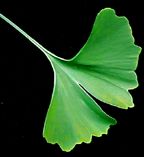 |
4350 Ginkgo biloba Unsexed seedling trees are
the most affordable bonsai material. Ginkgo will not form branches for
several years. Our 2 3/4 inch pots are one year and older whips and 4 to 6
inches tall.
FOUR INCH POTS $45
5215 Ilex serrata (Japanese
Winterberry) S\PS\M\-20ø zone 5\B. Deciduous shrub 4 to 10 feet with white
flowers and red berries in winter on leafless stems. The flowers are quite
small and the brilliant red berries are about 3/16 inch. In a good year,
the shrub is covered with berries. Highly valued as bonsai for its winter
display. This species is dioecious (male and female flowers on separate
plants) but will set (probably sterile) fruit without the presence of the
male. Having a male plant nearby may increase fruit production. Please
specify female or male plants.
Available Again in 2027?
| Articles | Home Page | Images | Order Form | Plant Catalog |