| Articles | Home Page | Images | Order Form | Plant Catalog | Tool Catalog |
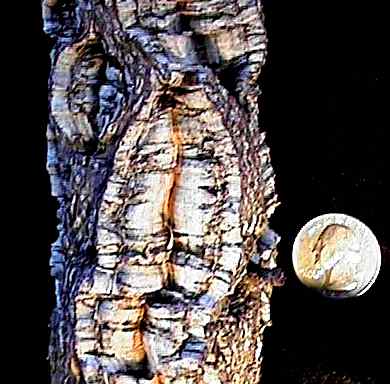
Quercus (Oak)S\D\Ls\B Deciduous and evergreen trees. Our oaks are native to the West and the Mediterranean and require dry soil conditions in summer once established in the ground (with exceptions listed below). All are extremely drought resistant. Cold hardiness is listed for each species below. All are excellent for bonsai. Cork Oak has been long used for bonsai and develops its corky bark in about five years even when kept small. The other oaks have been mostly overlooked for bonsai, however we have been using them for this purpose for nearly a decade with impressive results. Please note that all require excellent drainage and bright light when used for bonsai. Oak root fungus is not a problem in bonsai situations if soil-less mixtures are used. For landscape use, Oak root fungus is a problem if trees are frequently watered in summer after they are established.
7960 Quercus chrysolepis
(Canyon Live Oak, Gold Cup Oak) 0ø Evergreen tree to 25 feet
usually, but some stands are taller. Similar to Coast Live Oak except
that the
leaves are entire (smooth) with a prickle on the tip. Young trees will
have almost all holly like leaves changing to entire leaves as they get
older, however most trees will have at least a few holly shaped leaves.
The acorns are short and fat with a large almost corky cap covered with
bright yellow dust, thus the name Gold Cup. Long used for bonsai in
this country. These are a bit slow in containers and will be smaller
than our other oaks in the 2 3/4 inch pot size. Leaf reduction to about
one inch or less is quite easy. These make remarkable bonsai if one has
the patience to grow them out for five to ten years.
2 3/4 INCH POTS $8
7970 Quercus
douglasii (Blue
Oak) -40ø Deciduous tree to 30 feet usually. Native to
foothills of California inland valleys. Small lobed leaves are
decidedly blue gray. Very drought resistant and heat tolerant, however
it is quite susceptible to Oak root fungus and most remain dry in
summer. Large fat acorns every other year. Fissured and checked light
gray bark on old trees is very similar to Valley Oak. Can be used for
bonsai if planted in very lean soil mix, small leaves and rugged
appearance make it quite attractive.
2 3/4 INCH POTS $8 Available Sept
'08
7980 Quercus
dumosa
(Scrub Oak) -10ø Evergreen shrub or small tree to 10 feet.
Very small holly- like leaves and very slow growth make this a good
choice for a small Oak bonsai. Landscape use is limited. The one gallon
size, when available, have been pruned to make 4 to 10 inch bonsai,
very nice. Despite their slow growth these will trunk up pretty
quickly, making a nice shohin in five years or so with a one inch trunk
caliper.
2 3/4 INCH POTS $8
8010 Quercus
lobata
(Valley Oak) -40ø Deciduous tree to 70 feet with equal
spread, the most spectacular and best known of the California Oaks.
Small, lobed 'Oak' leaves deep green turning yellow in late fall on
massive branches that sometimes reach the ground. Long lived, drought
resistant, tolerating little summer water. An excellent bonsai species.
With diligent training small trees can imitate their massive ancestors.
Our 2 3/4 inch pot size will be tall thin stems with all their leaves
at the top. This is how the young plants grow. They should be grown out
for several years without pruning to develop the trunk and then cut
back. They bud back very nicely.
2 3/4 INCH POTS $8
8230
Sageretia thea (Chinese Sweetplum, Shina
Amai Ume) S\M\20ø\B Tropical evergreen small tree with shiny
green leaves that are almost bronze when they emerge. Stiff angular
growth. White flowers followed by black fruits. Very popular for indoor
bonsai. These can tolerate only very mild freezes, but allowing them to
go through a rest period in the fall before bringing them inside or in
a greenhouse seems to invigorate them. They are heavy feeders and
prefer ammoniacal forms of nitrogen. This can be supplied with an
occasional feeding with ammonium sulfate.
2 3/4 INCH POTS $8
Salix (Willow) S\PS\M\W\-30ø\RG\Ls\B Deciduous trees and shrubs. Nearly all Willows are fast growing moisture loving plants. Many have weeping or prostrate habit. We have selected those species that we have found to make outstanding rock garden, landscape, and bonsai plants. Many people will be surprised to learn that there are many willows that are absolutely prostrate, forming large flat mats of foliage and stems. For the most part it is these types and alpine varieties that make the best bonsai. All of the dwarfs are best grown with protection from afternoon sun in hottest driest areas. Because of their rapid growth all willows used for bonsai require frequent repotting.
8240 Salix alba tristis
(Golden Weeping Willow) Large landscape tree to 80 feet. Pendulous
branches hang down to the ground. Twigs are golden yellow. Must be
staked up until the trunk is strong enough to support the branches.
Heading back the side branches when young helps to develop a good
straight leader.
2 3/4 INCH POTS
$8 Available June '08
8245 Salix
babylonica
'Yatsubusa'(Dwarf Weeping Willow) A miniature weeping
willow for a small area or for bonsai. We have not grown out this tree
and do not know
its ultimate size. Its leaves and branches are about half size.
2 3/4 INCH POTS $8 Available June
'08
FOUR INCH POTS $12
8255 Salix arctica
A dwarf mounding willow to 12 inches x 18 inches with silver catkins
and small leaves. A clear favorite for bonsai and rock garden. It is
dwarf, but not prostrate when kept to a small size, and the leaves are
quite congested on the branches making a perfect little tree. Slow
growing. We formerly listed this species as Salix
'Lohbrenner'
Available again in 2009
8265 Salix gracilistyla
var.
melanostachys (Black Pussy Willow) Large
landscape willow with dark green leaves and purple black stems. The
catkins are a striking black with red anthers.
FOUR INCH POTS $12
8275 Salix nakumurana
'Yezo-Alpina' A very interesting large leaf dwarf from
Japan. The 3 inch almost round light green leaves emerge in spring
covered with silver hairs matching the quite large silver catkins. The
plant is a contradiction, with some of the largest leaves of any willow
and very fat short stems that arch to form a low mound to only 1 foot x
3 feet in 5 years. Excellent rock garden and bonsai plant for part
shade in all but the coolest areas. Shade required in hottest driest
areas.
2 3/4 INCH POTS $10 Available June
'08
8285 Salix repens
'Boyd's
Pendulous' A popular dwarf prostrate willow that
quickly grows to 6 inches x 6 feet with beautiful tiny silver catkins.
Good for landscape rock gardens and bonsai. You may take larger plants
and twist the long stems together to form an upright spiral trunk and
then allow the side branches to spill down the sides making a beautiful
tiny weeping willow for container or bonsai.
2 3/4 INCH POTS $8
8700
Sequoia sempervirens
(Coast Redwood) S\PS\M\-20ø\Ls\B Evergreen tree to 300 feet.
The world's tallest tree. Very green flat needle foliage and attractive
red shredding bark. Grows very fast, up to 6 feet a year given adequate
moisture. Can tolerate periods of drought but prefers regular watering.
Can be successfully used for larger bonsai. Our trees are relatively
straight and pruned down to about 16 inches tall. Caliper is about 1/4
inch. Seedlings.
2 3/4 INCH POTS $8 Available June
'08
8950
Sophora tetraptera nana
(Yellow Kowhai) S\PS\M\20ø\Ls\B Deciduous or
evergreen small tree or shrub to 10 feet with 2 inch leaves made up of
20-40 tiny leaflets. The very pronounced zig zag stems are yellowish
turning to brown. In mild climates the leaves fall just as the new
leaves appear. Flowers are golden yellow and hang in clusters. The very
tiny leaflets and intricate branching of this plant suggest that it
would make a nice bonsai. This is an extremely slow growing plant.
2 3/4 INCH POTS $10
Syringa (Lilac) S\M\Ls\B Deciduous shrubs. The two lilacs listed here are species rather than the showy large hybrids that are common. These listed below are dwarfs and will make good landscape plants for a small space as well as good flowering bonsai. Like all lilacs they prefer soil with high calcium levels and need winter chill to set flowers. They will not perform well in areas that stay above 25ø in winter.
| 9140
Syringa
laciniata
[syn. S. protolaciniata]
(Cut-leaf Lilac)-20ø A dwarf shrubby lilac to about 5 feet
with finely cut leaves and violet flowers. The small 2 inch leaves are
pinnately lobed and are quite unusual for a lilac. The flowers are
small and fragrant. This is a very twiggy lilac, even more so than
Dwarf Korean Lilac below and will make excellent bonsai. The leaves
reduce nicely and the plant forms a nice fat little trunk with good
taper in only a few years. As in all lilacs, the flowers form on
terminal buds and some branches must be left unpruned to get flowers,
however, this species has never set flowers for me in containers. 2 3/4 INCH POTS $8 |
![]() |
| 9150 Syringa
meyeri
'Palibin' [syn. S. palibiniana]
(Dwarf Korean Lilac)-10ø Shrubby growth to 4 feet. Often
confused with S. patula
or Korean Lilac which is larger (8 feet). This little lilac is a real
gem for those who crave lilacs but do not have the space. It grows
relatively quickly to 4 feet and flowers profusely even at a young age
(often our rooted cuttings flower in the propagation flat). The flowers
are a good lilac purple. The small size of the plant and the flowers
make it a good subject for bonsai. 2 3/4 INCH POTS $8 | ![]() |
9300
Taxodium distichum (Bald Cypress)
S\M\D\W\-30ø\Ls\B Deciduous conifer tree. A remarkably
adaptable tree as can be seen from the codes. It is drought resistant,
yet it can actually grow in standing water, where it will form 'knees'
or conical exposed roots. Relative of the Redwoods and the Dawn
Redwood. A fast growing tree to 100 feet is pyramidal in youth becoming
flat topped with age. Delicate needle-like foliage turns orange and
drops in the fall. Its fine foliage and buttressed trunk make it an
excellent subject for bonsai. Small containerized trees rarely form
knees. Our 2 3/4 inch pot trees are relatively straight and pruned down
to about 16 inches tall. One gallon trees are straight and pruned down
to about 16 inches repeatedly with trunk calipers of about 3/4 inch. In
winter these plants will be unbranched since Bald Cypress will drop
young branches each year for some time before beginning to form woody
branches.
2 3/4 INCH POTS $8
FOUR INCH POT SIZE $12
ONE GALLON SIZE $25
9510 Tilia
cordata (Little Leaf Linden)
S\M\-30ø\Ls\B A handsome deciduous tree to about 30 feet
with heart shaped leaves. Very heat resistant but needs moisture.
Leaves reduce nicely and it forms a thick trunk quickly making it a
very nice bonsai subject. Our one gallon size are pruned down to about
12 inches tall, well branched with about 1/2 caliper trunks.
2 3/4 INCH POTS $8
FOUR INCH POTS $12
| Articles | Home Page | Images | Order Form | Plant Catalog | Tool Catalog |