| Articles | Home Page | Images | Order Form | Plant Catalog |
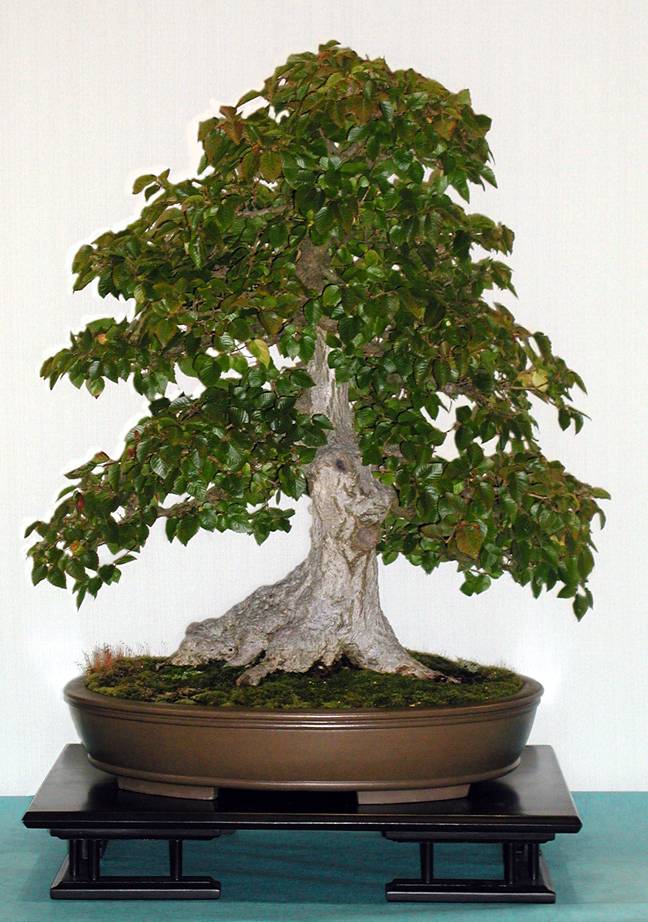
The growth rate of the hornbeam species varies greatly. This is of particular importance if you are growing them out for larger trunked bonsai. From fastest to slowest they rank: C. betulus, C. turczaninovii, C. japonica, C. laxiflora, C. caroliniana, C. coreana. C. coreana is very popular because of its small leaves and very ramified growth pattern. However, it takes a signifcantly longer time to achieve trunk caliper. There is really not much difference in the growth rate of C. japonica, C. laxiflora, and C. caroliniana. Mature hornbeam specimen will produce hop-like flowers and seed pods. This is an especially attractive addition for bonsai. Cutting produced plants from mature wood are capable of flowering in a year or two as opposed to seven years or more for seedlings.
We currently only offer C. coreana, and C. betulus. We consider these two of the best for bonsai. Korean hornbeam for smaller bonsai, and European for faster larger bonsai.
| 2065 Carpinus betulus (European
Hornbeam)S\M\Ls\B\-20ø? Pyramidal deciduous tree to forty feet.
Yellow fall color, leaves two to five inches, will reduce nicely
for bonsai. This species is often used for bonsai in the west. One
of the fastest growing hornbeams. Our 2 3/4 inch pot size plants
are relatively straight and pruned down to about 16 inches. One
gallon size plants are grown out and pruned down to about 16
inches to force low branching, and make excellent #1 trees for
group plantings. SIX INCH $45 Available June 2026 |
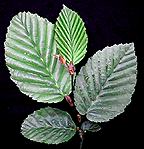 |
2067 Carpinus caroliniana (American
Hornbeam, Ironwoood) These are seedling grown hornbeam that are very
similar to the European hornbeam in growth habit and leaf size and shape.
They have a distinctive muscling of the trunk at the base of the tree when
allowed to gain some girth. The wood is very dense and hard and they are
an excellent candidate for larger bonsai.
2 3/4 INCH POTS $20 Available May 2026
FOUR INCH POTS $40 Available May 2026
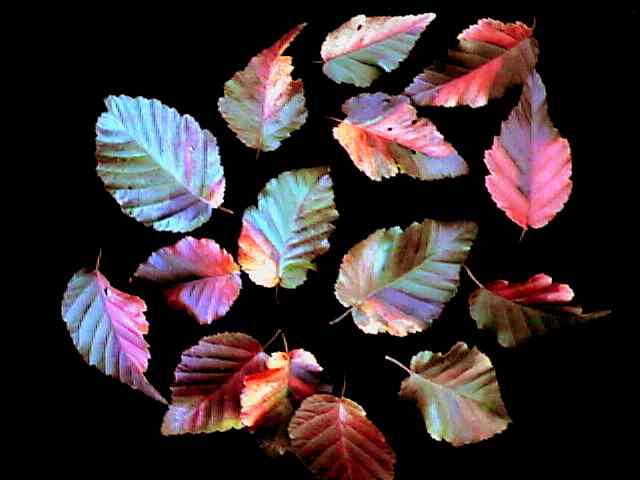
| 2070 Carpinus coreana (Korean
Hornbeam) -20F ? In our opinion the finest hornbeam for smaller
bonsai. The tiny pleated leaves reduce easily to under 1 inch and
it attains a zig-zag twiggy character after only a year in a
bonsai pot. The real treat is in the fall when the leaves turn
red, yellow and orange, not diffusely but in stripes. We have seen
leaves where one half of the leaf separated by the midvein was red
and the other half yellow or orange. The striping will also occur
between the side veins of the leaves. It should also make a very
nice small ornamental tree. Needs protection from afternoon sun
the hottest, driest areas. This is a slower growing hornbeam and
in general, it take twice as long as the other species to achieve
similar trunk caliper. Our 2 3/4 inch size plants are thinner than
the other hornbeams and rather willowy. They will require staking
and several years of growth to achieve the caliper of our one
gallon size plants. The one gallon size plants, when available,
are field grown, root pruned plants. They are grown out in one
gallon cans and then pruned down to about 12 inches. Trunk caliper
is about 3/8 to 1/2 inches, and they are nicely branched. When
available 2 3/4 inch pot size are about 10 inches tall with about
1/4 inch caliper. Seedlings. These seedlings have been difficult
to obtain and will sell out quickly. FOUR INCH POTS $35 SIX INCH POTS $55 |
 |
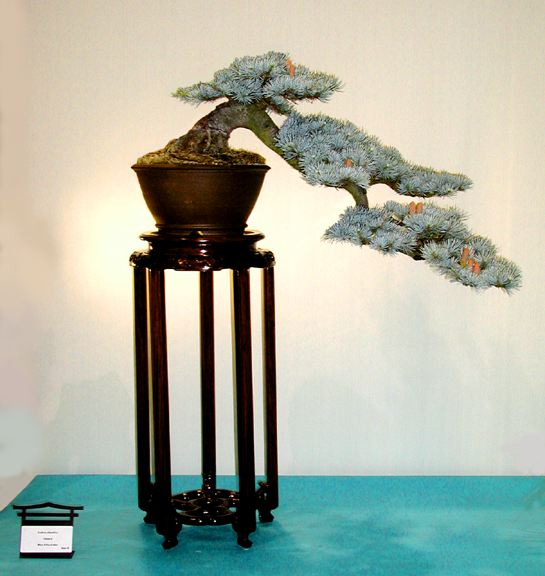
| Cedrus (Cedar) S\D\-10ø?
to 0ø\Ls\B Evergreen trees. True cedars are native the
Mediterranean and the Himalayas. They are easy to grow, tough,
drought resistant plants. Cold hardiness depends on the species.
Showy 'wood roses' seed cones, medium growth ultimately to 60 feet
or more except for dwarf and weeping types which can be shaped and
are very valuable for bonsai. True cedars, Cedrus
species, should not be confused with so called false cedars, Chamaecyparis
and some Juniperus species. Pictured is Jim
Gremel's award winning Cedar.
For more information see the article Cedars for Bonsai |
 |
2150 Cedrus atlantica (Atlas Cedar) -10°
Pale blue green foliage in tufts, much used for formal upright bonsai.
Native to the Atlas mountains of North Africa. 2 3/4 inch pots are 6 to 10
inches tall, 3/16 inch caliper. Seedling grown plants.
These are NOT the grafted cultivar
Blue Atlas Cedar, Cedrus atlantica
'Glauca', which
we only offer as specimen trees.
Available Again 2027?
2165 Cedrus libani (Cedar of Lebanon)
-20ø\Ls\B Slow growing; needles slightly longer than C. atlantica
at just over 1 inch long; Bright green, but still has a faint bluish cast;
spreads picturesquely as it matures. Excellent bonsai subject. Seedlings.
Available Again 2027
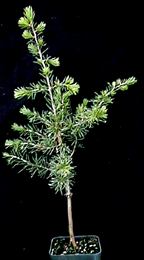
| 2170 Cedrus brevifolia (Cedar of
Cyprus) 0ø\Ls\B As 'Brevifolia' (small foliage) implies,
this rare tree is similar to the Cedar of Lebanon but smaller in
all aspects: needles, cones, height. It is also greener than C.
libani, which has a bluish cast. Rarely found in
cultivation, we have obtained seedlings of this tree that are very
short needled and remarkably uniform. The lack of a graft also
makes for superior bonsai, and a more economical value. Pictured
is 2 3/4 inch pot size. One gallon size will be pruned down to
about 16 inches with a trunk caliper of about 3/4 inch. They are
relatively straight and nicely branched. Pictured is 2 3/4 inch
pot size. This is the only cedar suitable for smaller bonsai. Sorry, Discontinued |
 |
Celtis
| 2179 Celtis occidentalis (Western
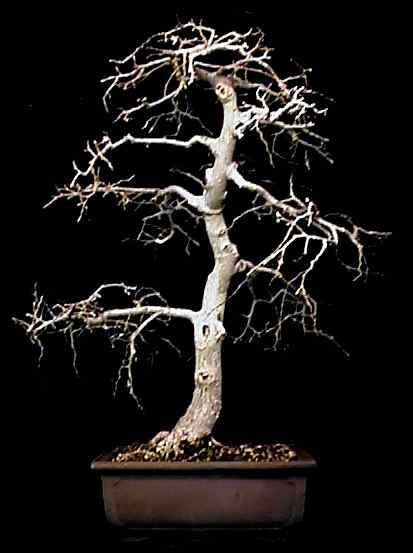
Hackberry) S\M\-40ø\Ls\B Deciduous tree to 75 feet tall, leaves lance shaped, 4 inches, but can be reduced incredibly in bonsai situations (to less than one inch). Bark is warty or furrowed, tan when young turning grey with age. Deep purple small round fruits. This is an incredibly tough tree that makes a beautiful bonsai, more suited, I believe, than even C. sinensis, the traditional bonsai species. This species is capable of incredible leaf and internode reduction. Shohin have 1/2 inch leaves with 1/4 inch internodes. In bonsai culture, the thin, fine branches have a tendency to arch in an almost weeping habit. Bonsai pictured is about 12 inches tall, five years in training. Seedlings. SIX INCH POTS $45 |
 |
Chaenomeles (Flowering Quince, Shudome) S\PS\M\-40ø\RG\Ls\B Deciduous shrubs. Used by the Chinese community in the San Francisco Bay Area as a substitute for peach and mume blossoms to celebrate the New Year, this plant flowers in the spring before it gets its new foliage making a striking display of color while the rest of the garden is still in its winter sleep. Large types are 8 to 10 feet, smaller types to 4 feet. Many flower colors and types including fully double ones.
An easy to grow and incredibly tough plant. Will withstand extreme cold and intense heat; grows in almost any soil. Prune while in flower or shortly after; flowers form on wood one year old or older. Most of the hybrid types set edible yellow fruits although it is so sour that it is only suitable for jam. However the ripening fruit is intensely fragrant and can be smelled throughout the garden in late fall. Try sticking a softened quince (use a microwave) in a chicken cavity before baking for a wonderful clean added flavor to the meat and add some to the gravy too. It is also a traditional bonsai plant, and the fruit is a real bonus, easily achieved even on bonsai sized plants. Chaenomeles should not be confused with so called Chinese quince which is Pseudocydonia sinensis, which are mainly grown for the fruit, not the flowers, and form tree like trunks.
Plants pruned in summer for bonsai will sometimes open a few flowers again in the fall. All of our plants are cutting grown and will flower the year after you receive them. Some cultivars require part sun or morning sun in the hottest driest locations. These will be indicated below. Many of these cultivars have been imported from Japan and are not in commercial production except through our nursery. All of our Chaenomeles are cutting grown plants one year or older. 2 3/4 inch pot size plants are pruned down to about six inches tall, and older plants will have moving trunks (curves achieved through pruning). We find moving trunks give added interest since it is virtually impossible to achieve any decent trunk caliper on Chaenomeles in a reasonable amount of time.
For more information see the article Flowering Quince for Bonsai
2185 Chaenomeles 'Apple Blossom' Pink and
white blossoms on a 6 foot x 8 foot plant. Profuse bloomer. This is a very
popular cultivar in the US. It is one of the larger types, suitable for
decent bonsai trunk formation.
FOUR INCH POTS $29
SIX INCH POTS $45
2190 Chaenomeles 'Bloodred'
A large single red flowered quince on a very thick trunk (for
Chaenomeles)with minimal suckering. It is one of the larger types,
suitable for decent bonsai trunk formation. Flowering is good, but not
quite as profuse as some of the other larger types.
FOUR INCH POTS $29
SIX INCH POTS $45
ONE GALLON SIZE $60
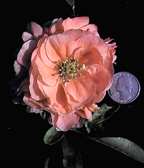
| 2200 Chaenomeles 'Cameo' A very
popular low type with no thorns and double salmon pink flowers. A
prolific bloomer often repeating in summer and fall. 2 3/4 INCH POTS $18 Available May 2026 |
 |
| 2207 Chaenomeles 'Chojubai Red' The
most highly desired dwarf Chaenomeles.
We can never grow enough of these and sell out early every year. A
traditional bonsai selection in Japan and the East where Spring red
flowers are highly prized. Red flowers and a small to tiny habit
sporting a gray rough bark. Not as strong growing as 'Chojubai
White' (below). This cultivar is very difficult to grow in our hot
dry climate, and is best kept above 20F in winter. We have been
keeping ours in a cold greenhouse in summer and winter and under 40%
shadecloth in summer. 2 3/4 INCH POTS $45 FOUR INCH POTS $65 Sorry, Sold Out SIX INCH POTS $85 Sorry Sold Out |
 |
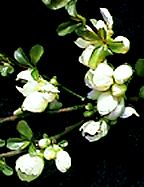
| 2208 Chaenomeles 'Chojubai White' This
is a one of the smallest cultivars (but a bit larger than
'Chojubai Red) with very pale small yellow flowers. This is as
close as one can get to the mythical yellow Quince. It is very
floriferous and a natural for small bonsai or accent plant. The
leaves are sometimes edged in white. Needs protection from
afternoon sun in the hottest, driest areas.Since Japanese names
did not always apply to 'cultivars' as we know them in the west
until recently, there are many problems in identifying clones from
Japan. These are fairly slow growing small plants with much
smaller leaves, flowers, and stems. They will be substantially
smaller than our other 2 3/4 inch Chaenomeles. 2 3/4 INCH POTS $18 Sorry, Sold Out |
 |
| 2210 Chaenomeles 'Chojuraku' A medium
tall type, grows to 6 feet. Very showy large double orange
flowers. This is an unusual flower color for a quince, very
striking. 2 3/4 INCH POTS $18 FOUR INCH POTS $29 ONE GALLON SIZE $60 |
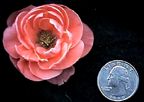 |
2228 Chaenomeles Contorted Salmon Pink' This
is an introduction from our nursery. It is an open pollinated seedling of
'Contorted White'. The flowers are a very nice salmon pink and
remain pink even as they age. The plant has all the contorta qualities,
even the roots are contorted.
2 3/4 INCH POTS $18 Sorry, Sold Out
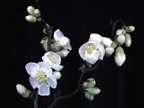
| 2230 Chaenomeles 'Contorted White' Similar
to above but accepts full sun and is more vigorous to 5 or 6 feet.
Pink buds open to single white flowers. Very floriferous and sets
large yellow fruit. This is a larger trunked cultivar suitable for
single stemmed bonsai specimen status. 2 3/4 INCH POTS $18 |
 |
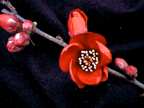
| 2240 Chaenomeles 'Embers' A low type
with profuse clusters of intensely saturated deep red single
flowers. Often repeats flowering in summer and fall. 2 3/4 INCH POTS $18 Sorry, Sold Out |
 |
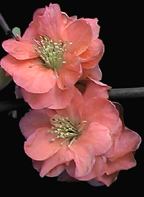
| 2245 Chaenomeles 'Falconet Charlotte' A
tall type with beautiful salmon pink double flowers. Rated one of
the best. Makes good single trunked bonsai, but is slower than
some of the other larger types. SIX INCH POTS $45 |
 |
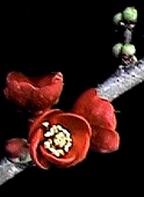
| 2250 Chaenomeles 'Hime' A low type
to 3 or 4 feet with profuse small single red flowers with
prominent yellow anthers. Often repeats bloom. The half inch wide
flowers and twiggy growth make it one of the best for smll bonsai
or as an accent plant. 2 3/4 INCH POTS $18 Sorry, Sold Out |
 |
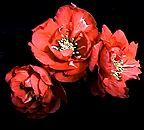
| 2255 Chaenomeles 'Iwai Nishiki' Deep
red double camellia shaped flowers in clusters that make a
spectacular display. This is the most striking Quince flower that
we have ever seen. Needs protection from afternoon sun in the
hottest driest locations. This is another one of the few Chaenomeles
cultivars that forms a reasonably thick trunk in a reasonable
amount of time. It tends to form a low spreading crown of thick
stems, 3 feet x 5 feet. 2 3/4 INCH POTS $18 FOUR INCH POTS $29 SIX INCH POTS $45 |
 |
2270 Chaenomeles 'Kingishi' A medium growing
plant to 4 or 5 feet with large single orange flowers. The flower color is
very similar to 'Chojuraku', but the flowers are single rather than
double.
FOUR INCH POTS $29
SIX INCH POTS $45
ONE GALLON SIZE $60
2278 Chaenomeles 'Kuro' Similar to 'Kurokoji'
below except that the flowers are a shade less deep red,
although still redder than any other quince you are likely to see. The
growth is nicer than 'Kurokoji', it is low growing with small
leaves and has good bonsai potential.
FOUR INCH POTS $29
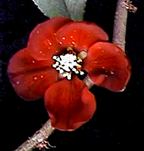
| 2280 Chaenomeles 'Kurokoji' A stiff
upright plant to about 6 feet with the deepest red single flowers
we have ever seen. The texture of the petals reminds one of red
velvet. Needs some protection from afternoon sun in hottest driest
locations. This quince does open flowers later, just before, or at
the same time as leaf bud break. This cultivar suckers more than
most quinces making a specimen bonsai difficult, but the intense
flowers make excellent accent plants. 2 3/4 INCH POTS $18 Sorry Sold Out |
 |
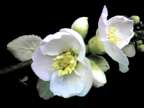
| 2300 Chaenomeles 'Nivalis' A tall
white single flowered form blooming after the leaves have
appeared. This is another cultivar that will form a reasonably
thick trunk. FOUR INCH POTS $29 SIX INCH POTS $45 |
 |
| 2305 Chaenomeles 'Not Minerva' This
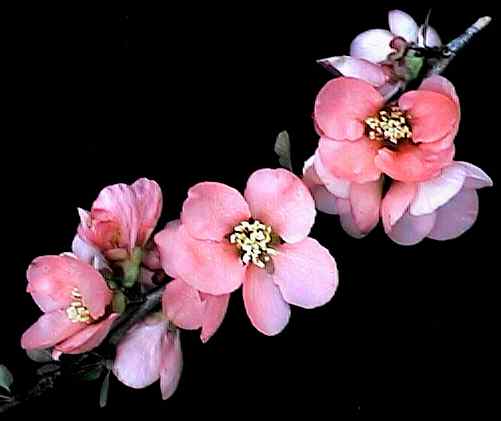
plant came to us as 'Minerva', but its soft pink flowers
made us realize that it could not be. So we started calling it
'Not Minerva', the name stuck, and now it seems nothing else fits.
The flowers were so nice we kept it and followed it for a few
years, then introduced it. Many people comment on the unusually
attractive flower color. It is undoubtedly a seedling, perhaps
from 'Minerva'. It is a hardy, vigorous plant but not large,
probably will grow to 5 feet. The additional attraction is the
abundance of fruit that this plant sets. It is absolutely loaded
with 2 inch yellow fruit in the fall. We have had as many as 4
fruit clinging to one of our 6 inch tall rooted cuttings in a 2
3/4 inch pot. The pleasing pink flowers, reliable fruit
production, and nice small, very dark green leaves, and good
branching should make it an excellent candidate for bonsai. 2 3/4 INCH POTS $18 FOUR INCH POTS $29 SIX INCH POTS $45 |
 |
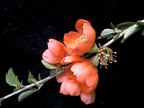
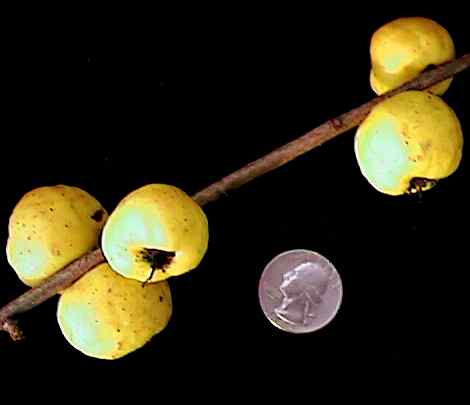
| 2310 Chaenomeles 'Orange Delight' A
very popular landscape plant with a profusion of single orange
flowers. Very low growing to 3 feet. Repeats blooms and sets many
small yellow fruits (pictured). Works well for smaller bonsai and
accent plants, and will set fruit easily on bonsai sized plants. 2 3/4 INCH POTS $18 |
 |
 |
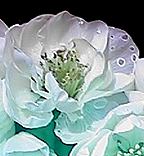
| 2320 Chaenomeles 'O Yashima' A
vigorous tall type to about 6 feet with large double white showy
flowers. Another cultivar that will form a reasonably thick trunk.
This is probably the most spectacular double white quince. 2 3/4 INCH POTS $18 Sorry, Sold Out |
 |
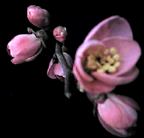
| 2330 Chaenomeles 'Pink Beauty' Medium
tall shrub with clear-pink flowers in early spring. This is a
strong grower that flowers well. 2 3/4 INCH POTS $18 FOUR INCH POTS $29 |
 |
| 2340 Chaenomeles 'Simonii Perfecta'
Smaller shrub with deep red medium size flowers in early spring.
This is a strong grower that flowers well and early. FOUR INCH POTS $29 ONE GALLON SIZE $60 |
 |
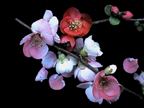
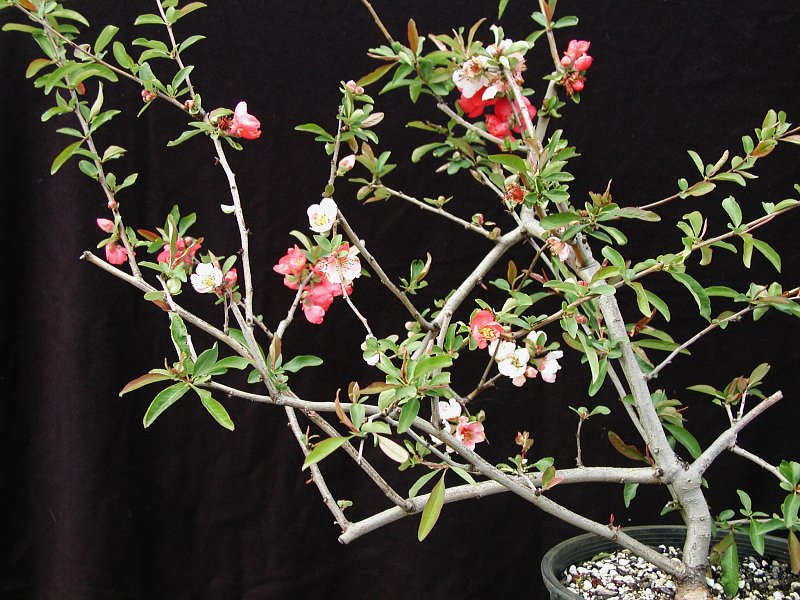
| 2370 Chaenomeles 'Toyo Nishiki' Unusual
form with pink and also white flowers on the same branch. This
cultivar is a chimera and will sometimes throw a branch of red
flowers only; a most exciting development when it happens. The
photo shows a stem of pink and white flowers with a stem of red
flowers. Much more rarely a cluster of flowers will be all three
colors together. Some years the individual petals will be striped
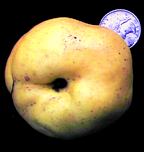
white, pink and red. The fruits can be quite large as shown by the
lower photo. A very vigorous upright tall type to 6 or 7 feet with
wicked thorns. Bonsai with all three colors are usually the result
of grafted plants, where a branch of red only flowers is grafted
in the desired location. Red flowering branches do not have any
pink or white flowers and June be cutting propagated to produce
plants that have red flowers only. Plants of these red only
flowers are extremely rare. We offer these to those of you who
wish to graft to produce true three color 'Toyo Nishiki'
bonsai. This is a large stemmed cultivar suitable for specimen
plants and probably the most popular cultivar for bonsai. 2 3/4 INCH POTS $18 FOUR INCH POTS $29 |
  |
| 2371Chaenomeles 'Toyo Nishiki Improved'This
introduction has been ten years in the making. Nearly all of the
'Toyo Nishiki' flowering quince on the market are of the type shown
above, basically pink and white flowers with a rare branch of pure
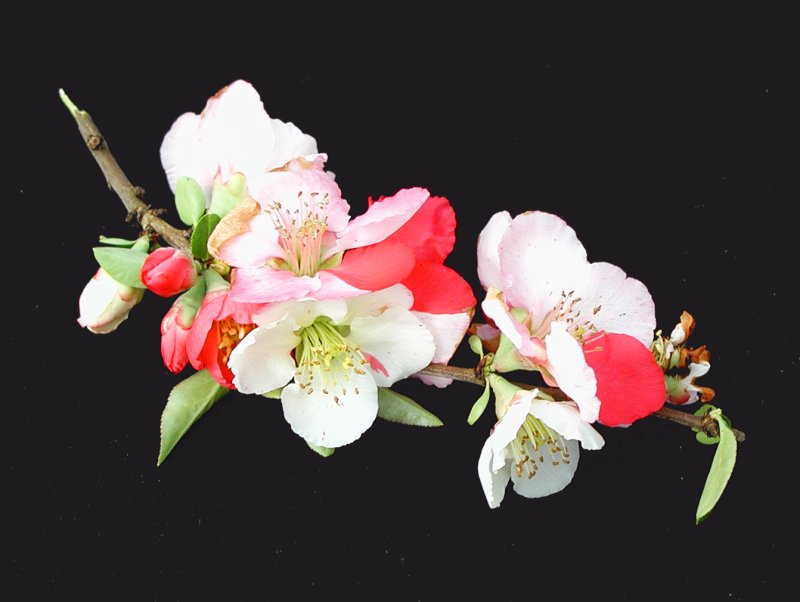
red flowers. Occasionally you will see a multi-colored flower. About
ten years ago, one of our stock plants sported a branch with flowers
of all three colors and also multi-colored single flowers such as
the ones pictured here. These are just like the flower patterns of
Satsuki azaleas. We have been watching the stock plants and
offspring from this sport for a decade now and it appears to be
stable. The photoat the right was taken in 2013 (click on image for
larger size). The flowering is variable and quite unpredictable.
Some branches (see lower photo) will be mostly red flowers, others
mostly pink and white, but nearly all will also have multi-colored
flowers as well. Unfortunately, this cultivar has reverted to red 'Toyo Nishiki' for us. We are working to get the 3 color form back again and hope to offer it in the future. NOT AVAILABLE AT THIS TIME |
 |
 |
| Articles | Home Page | Images | Order Form | Plant Catalog |